- Loans
- Deposits
- Cards
- Payments and transfers
- Premium offers
-
Other services
- Coin store
- Buying bank metals
- Personal banking safes
- DGBU
- Currency swap for private clients
- Forward transactions for individuals
- Depositary activity
- Mobile banking Pivdenny Online
- Chatbot
- Apple Pay
- Google Pay
- Pivdenny MyBank internet banking
- BankID
- Mastercard Більше
- Promotion winners
- Insurance
- Sevrice Click to Pay
Pivdenny Bank joins the Employers’ Council of the Faculty of Economics of the National University of Kyiv to help shape the next generation of professionals
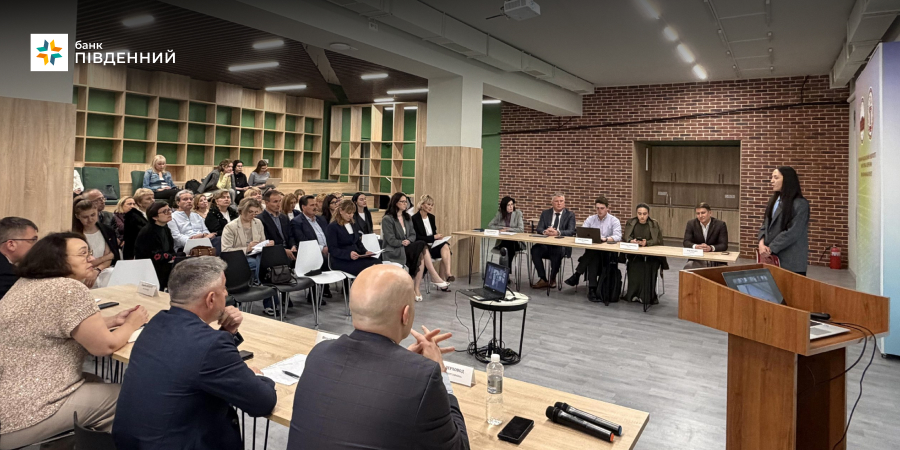
How can the gap between higher education and labour market needs be narrowed? Which skills will define successful careers in the age of artificial intelligence? And how can graduates adapt more quickly to their first jobs? These questions were at the centre of a meeting of the Employers’ Council of the Faculty of Economics at Taras Shevchenko National University of Kyiv.
Pivdenny Bank participated in the Council’s work as both an employer and a long-standing university partner. Alla Vanetsiants, Chair of the Bank’s Management Board, serves in the Council’s Presidium, while the Bank itself has been implementing the Academic Hub Pivdenny educational programme at the university for the past three years. The Bank was represented at the meeting by Vitalii Hahauz, Director of the Valuation and Collateral Operations Department and leader of the Academic Hub project.
Representatives of business, government, and academia discussed the challenges currently faced by both students and employers, as well as ways to better align academic education with the practical needs of today’s labour market.
One of the central topics was students’ uncertainty regarding their future careers. According to Vitalii Hahauz, employers increasingly encounter senior students who have not yet decided which professional path they wish to pursue. This uncertainty affects both their choice of first employment and their subsequent adaptation within the company.
Another important challenge is the lengthy onboarding process for recent graduates. Employers estimate that, even with strong commitment from both parties, successful adaptation may take between three and six months.
The impact of artificial intelligence on the labour market also featured prominently in the discussion. Participants agreed that while AI is transforming professional requirements and creating new opportunities, it cannot replace human expertise.
“Many people believe that artificial intelligence will eliminate jobs. In reality, those who learn to use it effectively as a tool will have a competitive advantage. AI should serve as an assistant, not as a substitute for professional judgement,” said Vitalii Hahauz.
He noted that this is particularly relevant for the financial sector, where data accuracy, information verification, and accountability for decision-making remain essential.
The Council also discussed the skills expected to be most valuable in the coming years, including strong foundations in mathematics and economics, critical thinking, the ability to analyse large arrays of data, and effective communication skills.
“Technology can automate many processes, but it cannot replace the ability to work with people, collaborate in teams, and develop creative solutions. That is why soft skills remain just as important as professional knowledge,” Vitalii Hahauz added.
Speaking about practical approaches, he highlighted the experience of Academic Hub Pivdenny:
”When students have an opportunity to engage with business leaders, observe real business processes and gain insight into different professional fields, it becomes much easier for them to define their own career path. That is precisely why Academic Hub introduces young people to a wide range of professions and provides practical insight into their future careers.”
This approach not only better prepares students for entering the labour market but also significantly shortens the adaptation period after employment.
The meeting concluded with a discussion of new models of cooperation between universities and employers. In particular, the Faculty of Economics presented its work-based learning concept, which aims to integrate practical experience more deeply into the educational process while strengthening business involvement in the training of future professionals.
Participants agreed that, in a rapidly evolving labour market, close cooperation between universities and employers is one of the key factors in preparing competitive specialists who are ready to meet the challenges of the modern economy.