- Loans
- Deposits
- Cards
- Payments and transfers
- Premium offers
-
Other services
- Coin store
- Buying bank metals
- Personal banking safes
- DGBU
- Currency swap for private clients
- Forward transactions for individuals
- Depositary activity
- Mobile banking Pivdenny Online
- Chatbot
- Apple Pay
- Google Pay
- Pivdenny MyBank internet banking
- BankID
- Mastercard Більше
- Promotion winners
- Insurance
- Sevrice Click to Pay
Business Financial Analysis: Workshop at Academic Hub Pivdenny
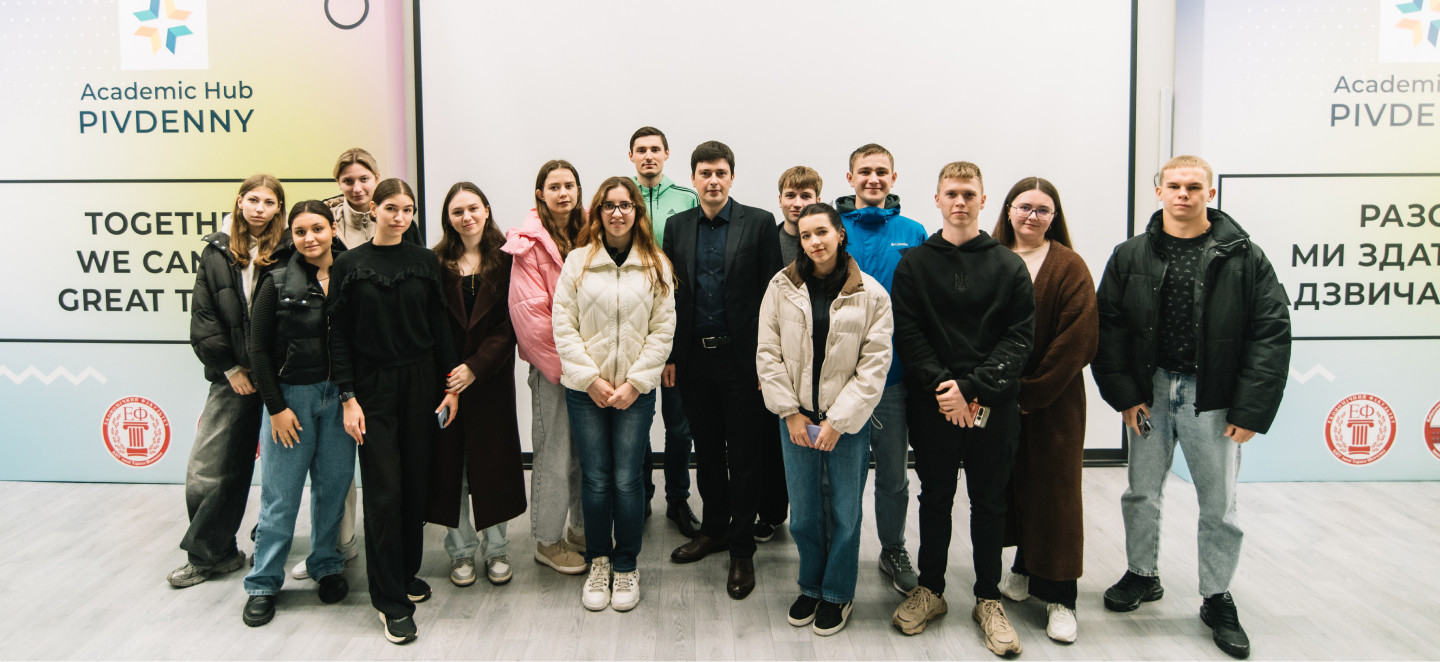
Experts from Pivdenny Bank continue to share practical cases and experience with students of the Faculty of Economics at Taras Shevchenko National University of Kyiv. The third workshop of the fall semester course “Managerial Thinking: Modern Approaches and Practices” was dedicated to analyzing the financial condition of businesses.
Viacheslav Hnatiuk, Head of the Small and Medium Business Analysis Department at Pivdenny Bank, shared his impressions of interacting with the students.
Which topics did you discuss during the workshop?
The main focus was the essence of financial analysis for the companies, as well as the role and tasks of a corporate business analyst. We discussed the importance of financial analysis in making banking decisions and paid special attention to data sources for analysis: financial statements, market data, detailed analysis of the balance sheet, profit and loss statement, and cash flow statement. Key metrics were examined using practical examples.
This is the second workshop you’ve held for students. How has the contents or audience reaction changed?
The contents became deeper and more practical. The audience, as before, was very engaged: students asked questions, shared examples from their academic cases, and participated actively in the discussions. There was more interactivity, less theoretical definition – the focus was on decision-making logic and cause-and-effect relationships in financial indicators.
A week after the workshop, a seminar will traditionally take place. What will it consist of?
The seminar will continue the topic with a practical analysis of a real company’s financial statements. During the seminar, we will conduct a basic financial analysis of the company that students are preparing as a homework assignment – calculating key ratios, assessing its financial condition, and reviewing important debt metrics. While the workshop was more lecture-based with discussion elements, the seminar will focus on the practical application of knowledge.
Were there any memorable questions from students?
Students were just as curious as last time. They asked how bank analysts use artificial intelligence and how much it can simplify the analyst’s work today. They were also interested in current changes in analytical approaches considering the economic situation and wartime risks. Some questions focused on how the current macroeconomic and war conditions affect the performance of an average bank borrower.
What expectations did you have going to the workshop? Did the reality meet them?
Since this was my second workshop, expectations were quite optimistic. I anticipated an engaging dialogue rather than a one-way lecture – and those expectations were fully met. There were lively discussions, interesting comparisons, a hearty humor, and a strong desire to understand complex topics. I aimed to show the practical side of analytics, and I succeeded!
I particularly enjoyed the feeling of the dialogue rather than the monologue. Students were highly engaged, responded to examples, and suggested their own approaches. Many already had basic knowledge in finance. The most rewarding aspect was the general interest in the analyst profession and understanding of its importance for the banking business.