- Loans
- Deposits
- Cards
- Payments and transfers
- Premium offers
-
Other services
- Coin store
- Buying bank metals
- Personal banking safes
- DGBU
- Currency swap for private clients
- Forward transactions for individuals
- Depositary activity
- Mobile banking Pivdenny Online
- Chatbot
- Apple Pay
- Google Pay
- Pivdenny MyBank internet banking
- BankID
- Mastercard Більше
- Promotion winners
- Insurance
- Sevrice Click to Pay
Solar power plant construction with Pivdenny Bank: myths, fears, and real solutions
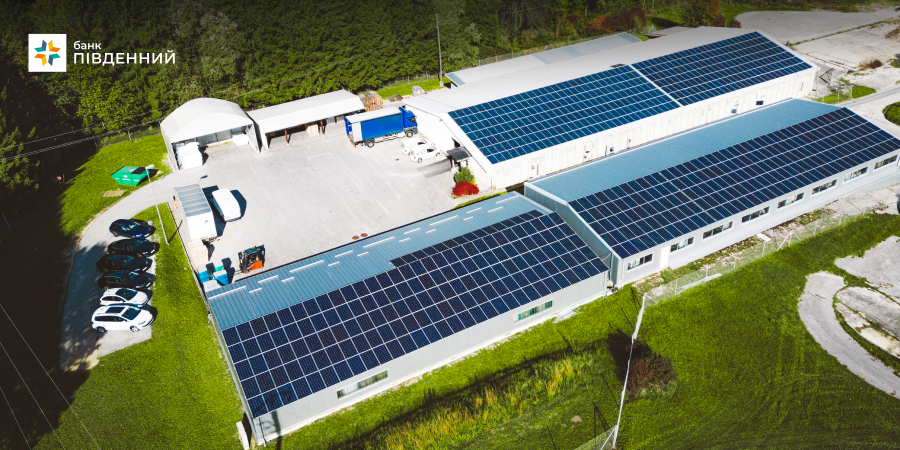
Solar power plants for businesses in Ukraine are becoming a common practice. At the same time, even in the face of rising tariffs, energy instability, and declining equipment costs, some companies continue to postpone decisions about installing solar power plants. The reason is persistent objections and fears that often do not correspond to market realities.
The practice of working with business clients shows that most doubts about SPPs can be reduced to four key theses. And each of them needs to be reconsidered.
Objection one: SPP will not cover all the energy needs of a business
This is one of the most common arguments - and at the same time, one of the most misleading. A solar power plant is not intended to fully replace grid electricity consumption. Its efficiency lies in reducing the share of expensive energy purchases.
The optimal model is when SPP covers about 30–50% of a business's consumption. It is under this scenario that the investment works most effectively: without excessive equipment costs and with the fastest possible ROI by consuming all the solar generation. Attempts to “cover everything” lead to over-installing capacity that remains underutilized in winter and generates an unusable surplus in summer.
Companies that install or already have excess solar generation are additionally integrating energy storage systems. This allows accumulating the daytime surplus and use it during peak hours with the highest evening tariffs. In this way, SPP becomes a tool for cost optimization rather than a universal replacement for the power grid.
Objection two: It is expensive, and ROI is unclear
Practical experience shows that without external financing, a solar power plant for business pays for itself within 1.5 to 2 years on average, depending on the project's scale. Even with credit at market rates, the payback period usually does not exceed three years.
Under partnership programs or government business support schemes, this period can be reduced to 2–2.5 years. Crucially, the project's economics are based solely on direct energy cost savings, without relying on complex or risky income models.
The factors favoring SPPs today are clear: over the last five years, equipment costs have dropped nearly threefold, while electricity tariffs have seen a similar increase and continue to rise. Additionally, businesses suffer losses from downtime and production disruptions caused by unstable power supplies. In this context, investment in SPP is not an expense but a tool for ensuring stability and predictability of operating costs.
Objection three: There is no confidence in suppliers and service support
The SPP market in Ukraine is already well-established. Today, it is represented by companies with proven expertise, solid reputations, and reliable after-sales support. It is with such players that Pivdenny Bank implements its partnership programs.
The bank’s participation in a project serves as an additional guarantee for the business: the partner is vetted, the contract terms are strictly defined, and the fulfillment of obligations is monitored not only by the client but also by the bank. This significantly reduces risks related to equipment quality, installation deadlines, and ongoing maintenance.
Objection four: The war creates risks that are too high for investment
It is the wartime environment that has forced businesses to re-evaluate not only the risks of taking action but also the losses from inaction, motivating them to invest more actively in their own energy resilience. Today, the regulatory procedures for the construction and commissioning of SPPs have been simplified as much as possible. Processes are faster than they were a few years ago, requiring less time and fewer resources.
Suppliers have already adapted their logistics: key equipment is stored in secured warehouses or near the EU border, while a significant portion of mounting components and cable products is mostly manufactured in Ukraine. Furthermore, some energy equipment is imported duty-free and without VAT, which further reduces the overall project cost.
The cost of inaction: what businesses often underestimate
In three years, a company can pay the electricity supplier an amount equivalent to the cost of its own solar power plant – and not receive any asset. Instead, a solar plant operates for 15-20 years, generating savings and reducing dependence on external risks.
In addition, it is worth considering not only the increase in electricity tariffs, but also the future increase in the cost of distribution and transmission. It is these tariff components that will increase the most due to the need to restore damaged networks.
Real risks of SPPs and how to manage them
The most critical risks at the start of a project are errors in power capacity calculations and incorrect equipment selection. These can lead to a station that is either underpowered or oversized, failing to deliver the desired economic effect or becoming technically incompatible with the enterprise’s existing power grid.
Another risk involves unscrupulous contractors who offer standard solutions without considering the business’s actual needs, the state of the grid, or the existing energy equipment.
These risks are neutralized through a comprehensive approach to project implementation, the availability of multiple design options for comparison, and professional engineering expertise.
The role of Pivdenny Bank in reducing risks
During the planning stage, the bank helps the business refine the project’s economic model and find the most optimal technical and financial solution tailored to its specific needs. We offer cooperation with vetted suppliers, world-class equipment, and transparent contracts. The bank’s experts verify the market value of the project and the equipment set, calculate the financial payback model, and monitor the fulfillment of contract terms to protect the client’s interests.
In partnership programs, the bank acts as a third party to the agreement. This ensures control over construction stages, adherence to deadlines, and the protection of the client’s interests.
Loan repayment is covered by the savings on electricity costs. Consequently, working capital is not withdrawn from operations; in fact, the business’s operating profit actually increases.
The economics of SPPs have shifted significantly in favor of business in recent years: equipment has become more affordable, efficiency has increased, risks have decreased, and the costs of delay have become more tangible. For businesses today, a solar power plant is not an experiment but a practical solution for cost reduction and increased resilience.
Details about partner programs can be obtained by contacting the corporate centers of Pivdenny Bank or by submitting a request on the bank’s website.