- Loans
- Deposits
- Cards
- Payments and transfers
- Premium offers
-
Other services
- Coin store
- Buying bank metals
- Personal banking safes
- DGBU
- Currency swap for private clients
- Forward transactions for individuals
- Depositary activity
- Mobile banking Pivdenny Online
- Chatbot
- Apple Pay
- Google Pay
- Pivdenny MyBank internet banking
- BankID
- Mastercard Більше
- Promotion winners
- Insurance
- Sevrice Click to Pay
SPP with Pivdenny: from savings to business scaling
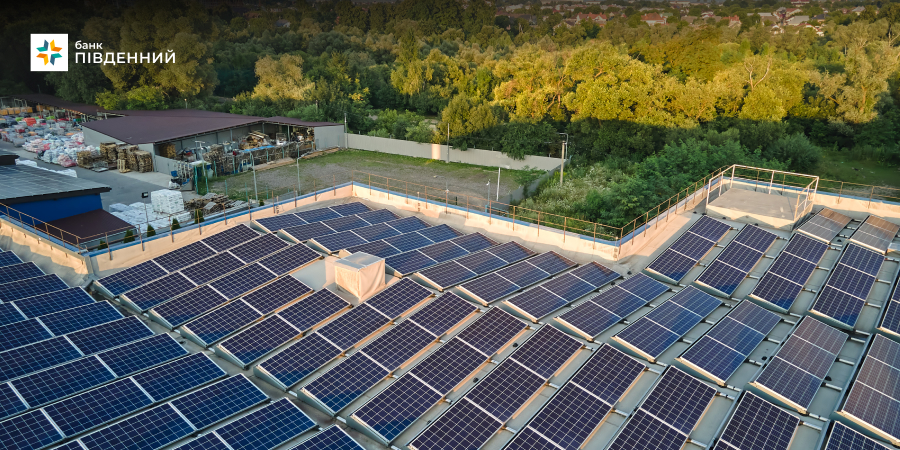
Savings on electricity are just one of the results of installing a solar power plant. In practice, a business receives significantly more: cost control, more stable enterprise operation, and new opportunities for development. The experience of Pivdenny Bank clients shows which effects become noticeable as early as the first months of SPP operation and why the practice of implemented projects helps to evaluate new ones more accurately.
What results does a business see as early as the first months of SPP operation?
Switching to your own solar power plant is not just a change in the source of electricity. In fact, the company gains the ability to manage one of the least controllable operating expense items.
A business feels the first effect immediately after the launch of the plant: part of the consumption shifts to own generation, and electricity bills begin to decrease from the very first month.
However, practice shows that the changes are not limited to savings. Thanks to SPP online monitoring systems, enterprises begin to better understand their own energy consumption and consciously shift the most energy-intensive processes to the hours of maximum generation. This allows for reducing the cost of production not only by saving on electricity expenses but also through more efficient organisation of production.
What does real saving depend on?
On average, companies reduce electricity expenses by 30-40% per year. In the summer months, savings can reach 80%, while in winter they usually amount to 20-25%.
At the same time, these figures are not universal. Four factors influence the result the most: the consumption profile of the enterprise, correctly selected capacity and configuration of the plant, as well as current electricity tariffs.
The most efficient stations are those where almost all produced electricity is used by the enterprise. That is why, even at the design stage, it is important not just to determine the capacity of the SPP, but to take into account the actual business operating schedule.
Savings are only one of the advantages
In practice, self-generation gives a business much more than just lower electricity bills.
Modern industrial inverters help to stabilise the enterprise's internal network and protect equipment from voltage surges. If an SPP operates together with an energy storage system, the enterprise achieves a significantly higher level of energy autonomy.
Another advantage noted by clients is the opportunity for development. If an enterprise consumes mainly its own electricity during the day, a portion of the permitted external grid capacity is freed up. This makes it possible to connect new equipment or launch additional production lines without lengthy procedures for increasing connected capacity.
One of the cases of Pivdenny Bank is a manufacturing enterprise that installed an SPP exclusively to reduce electricity costs. During operation, it turned out that the solar station fully covers the plant's needs during the day, so the enterprise has almost stopped using the permitted external grid capacity. The company directed the freed-up resource towards launching a new production line – without additional costs or lengthy approvals for increasing capacity. As a result, the SPP, which was initially viewed as a tool for savings, became one of the factors for scaling the business.
Why does an SPP make costs more predictable?
For most enterprises, electricity remains an item of expenditure that is almost impossible to influence. Tariffs are changing, electricity transmission costs are rising, and the situation in the energy system remains unstable.
That is precisely why an investment in an SPP can be viewed as an opportunity to fix the cost of a portion of electricity for the next 20–25 years. Once the plant is installed, its cost price remains practically unchanged regardless of inflation or regulator decisions.
For a business, this means the ability to more accurately plan the cost price of products and long-term financial indicators.
Practice often exceeds expectations
Over the last few years, the attitude of businesses towards SPPs has changed significantly. While previously such projects were viewed primarily as a way to reduce electricity bills, today they are becoming a tool for long-term cost management, development, and increasing enterprise resilience.
The experience of implemented projects shows: today, an SPP for a business is not just a way to cut electricity costs. With proper design, it becomes a tool for increasing operational resilience and cost predictability, and it creates new opportunities for business development.